
 2025-12-26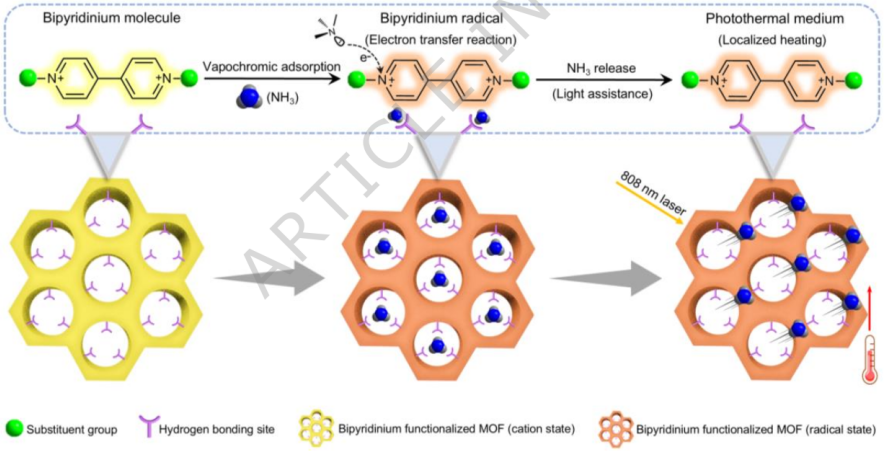
Recently, a research team led by Dr. Yang Xiaodong, a young faculty member at the School of Chemistry and Chemical Engineering, published a paper titled Photothermal-assisted NH₃ release in a bipyridinium-functionalized metal-organic framework adsorbent in the prestigious journal Nature Communications. Dr. Yang serves as the first author and corresponding author, while Professor Xuan Xiaopeng and Professor Zhang Jie from Beijing Institute of Technology are co-corresponding authors. Henan Normal University is the first corresponding affiliation.
Ammonia, a critical raw material in industrial and agricultural applications, is both toxic and corrosive. Its efficient capture and detection have long posed significant challenges in the field. Traditional metal-organic frameworks (MOFs) require high-temperature vacuum treatment for ammonia desorption after adsorption, resulting in high energy consumption that severely limits their industrial application potential. Addressing this challenge, the research team developed a novel bipyridinium-functionalized MOF adsorbent for ammonia. The synthesis method is straightforward and enables gram-scale production, establishing a solid foundation for industrial applications. The material’s pore structure is rich in uncoordinated carboxylate oxygen atoms, which function as hydrogen-bonding sites to efficiently capture ammonia molecules. This design endows the adsorbent with rapid response capabilities and a low detection limit for ammonia sensing. Furthermore, the resulting radical-state product exhibits exceptional photothermal performance. Under 808 nm laser irradiation, it rapidly reaches a temperature of 121 °C, achieving a photothermal conversion efficiency of 80.75%. This localized photothermal effect effectively disrupts hydrogen bonding, enabling precise, controlled release of ammonia molecules—a process significantly more efficient than conventional thermal desorption methods. Additionally, the adsorbent demonstrates outstanding stability, with no noticeable performance degradation observed across multiple adsorption-desorption cycles.
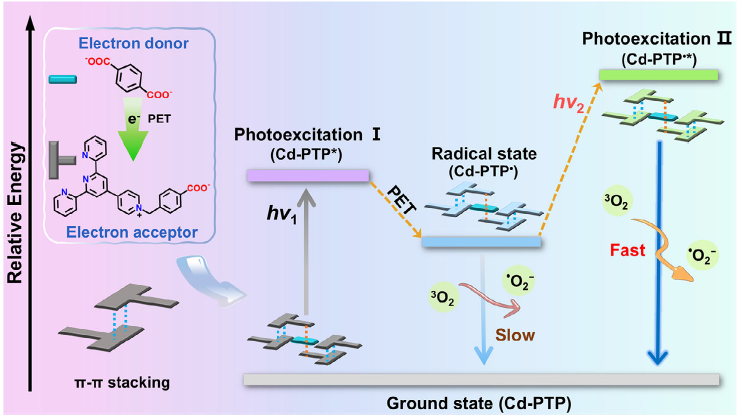
In parallel, the team collaborated with Professor Zhang Jie from Beijing Institute of Technology to publish another paper, Bidirectional Photoregulated Chromism in Pyridinium Derivatives via Secondary Excitation-Driven Electron Transfer, in Angewandte Chemie International Edition. This study employs a secondary excitation strategy that leverages multi-wavelength synergistic irradiation across ultraviolet, visible, and near-infrared spectral regions. By doing so, it overcomes fundamental control limitations inherent in traditional photochromic materials. The research successfully achieves bidirectional, controllable photochromic modulation of pyridinium radicals, providing new insights for the development of environment-responsive smart materials. Dr. Yang Xiaodong and Professor Zhang Jie from Beijing Institute of Technology are co-corresponding authors for this paper, with Henan Normal University serving as a co-corresponding affiliation.
Paper Links:
https://www.nature.com/articles/s41467-025-66380-w
https://onlinelibrary.wiley.com/doi/10.1002/anie.202523781
(By Xie Mingsheng, School of Chemistry and Chemical Engineering)