
 2025-12-31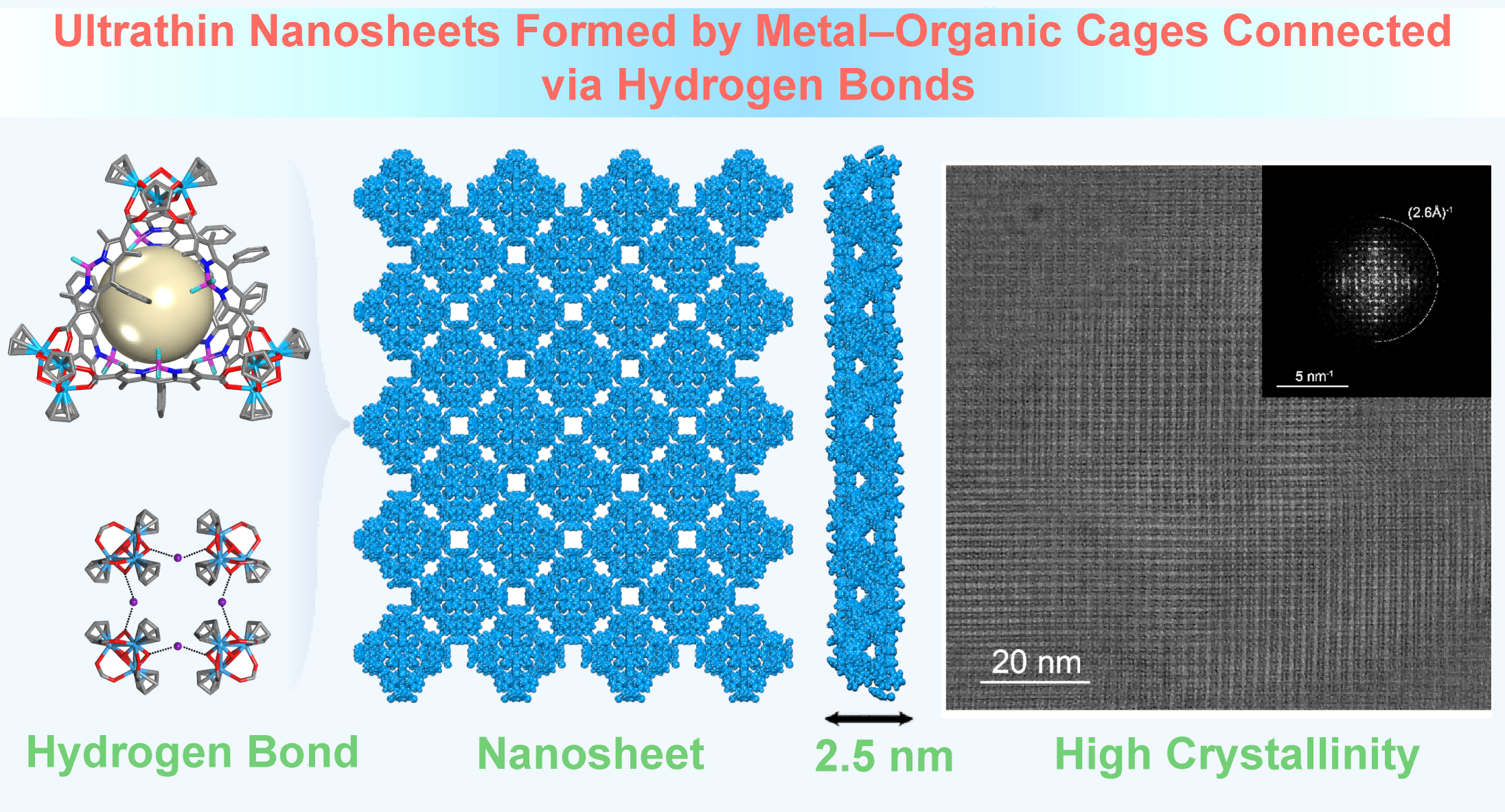
Recently, Xia Qingchun, a junior faculty member from the Boron Chemistry research group at the School of Chemistry and Chemical Engineering at Henan Normal University, published a research paper titled Ultrathin Nanosheets Formed by Metal–Organic Cages Connected via Hydrogen Bonds in the international chemistry journal Journal of the American Chemical Society. Liu Binhui, a 2025 master’s graduate student, and Peng Suping, a 2024 master’s graduate student from the School of Chemistry and Chemical Engineering, are co-first authors of the paper. Xia Qingchun is the corresponding author, and Henan Normal University is the first corresponding affiliation.
Traditional two-dimensional (2D) materials typically rely on strong covalent or coordination bonds to maintain structural stability. Departing from this conventional approach, the researchers pioneered a novel method, utilizing directional hydrogen bonding to orderly assemble discrete metal-organic cage (MOC) units in a two-dimensional plane. This yielded high-quality nanosheets with a thickness of only 2-6 nanometers and lateral dimensions up to 100 micrometers. Cryo-electron microscopy characterization techniques clearly revealed the ordered arrangement of MOCs within the material and confirmed that the hydrogen bond network fully supports the macroscopic structural integrity of the nanosheets. In photocatalytic performance tests, the material demonstrated excellent catalytic activity, particularly exhibiting significantly enhanced activity in the transformation of spatially demanding substrates. This work not only innovatively establishes MOCs as a new platform for constructing 2D materials but also demonstrates that hydrogen bonds, as weak intermolecular forces, can similarly construct and stabilize macroscopic 2D material structures. This opens a new chapter in the development of 2D materials.
Paper Link:
https://doi.org/10.1021/jacs.5c19910
(By Xie Mingsheng, School of Chemistry and Chemical Engineering)