
 2026-03-23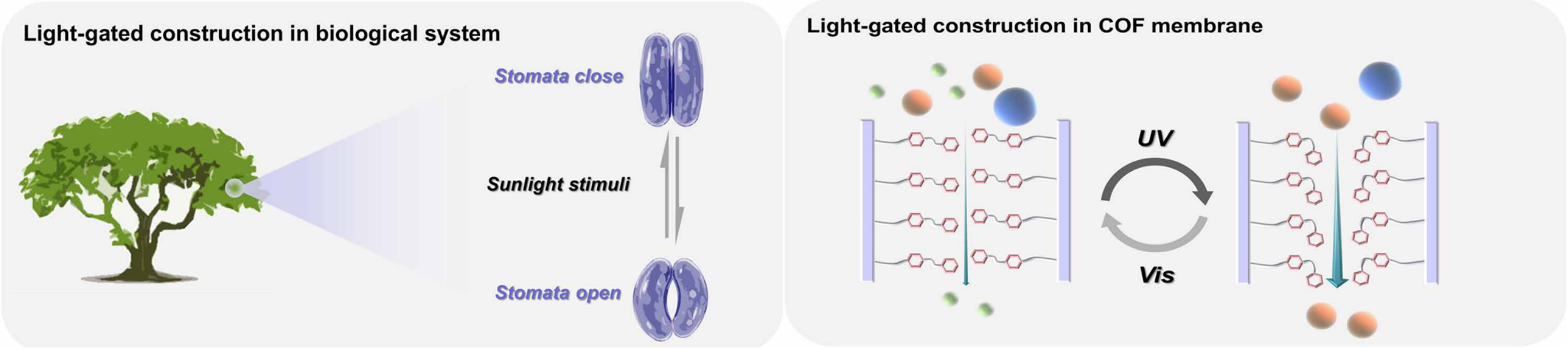
Recently, the Green Chemistry research team of our university published a research paper titled Highly efficient light-gated COF membrane for precise multistage molecular separation in Science Advances, a journal in the Science family. Zhai Liyong, a doctoral student from the School of Chemistry and Chemical Engineering, is the first author of the paper; Professor Wang Jianji, Associate Professor Li Zhiyong and Associate Professor Gao Shuaiqi are the co-corresponding authors; and Henan Normal University is the first affiliation.
Membrane separation has the advantages of low energy consumption and environmental friendliness. However, the separation of traditional multi-molecular mixtures relies on membranes with different pore sizes connected in series, resulting in such problems as low efficiency and high energy consumption. Inspired by the light-regulated opening and closing of plant stomata in nature, this study provides inspiration for regulating membrane pore size with light. Through a click reaction, azobenzene molecules were anchored into the nanochannels of a covalent organic framework (COF) membrane with a grafting efficiency as high as 98.5%, successfully producing a stable light-gated COF membrane with rapid photoresponse. Owing to its reversibly light-switchable pore size ranging from 0.73 to 0.93 nm, this COF membrane can separate cannabidiol oil, a high-value pharmaceutical, limonene and chlorophyll from hemp oil extract in situ, and can also precisely screen ions such as gold, silver and iron from natural ores. Meanwhile, based on stable triazole bonds that fix azobenzene molecules within the framework channels, the membrane maintained stable separation performance and crystalline structure after more than 100 light-controlled cycles and continuous operation for as long as 12 days, demonstrating promising prospects for practical application.
This achievement marks an important advance made by our university in the field of precise molecular separation using light-gated smart COF membranes. It realizes a leap in membrane separation from “static sieving” to “intelligent regulation,” provides new ideas for developing light-gated smart membranes for precise molecular separation, and is expected to significantly reduce energy consumption and production costs in separation processes, thereby serving the national “dual carbon” strategic goals. This research was supported by the National Natural Science Foundation of China, the Henan Provincial Science and Technology Innovation Talent Program, and other projects.
Paper link:https://www.science.org/doi/10.1126/sciadv.adz1929
(Zhi Shaoyang, Department of Science and Technology; Li Bin and Wang Manman, School of Chemistry and Chemical Engineering)