
 2026-04-05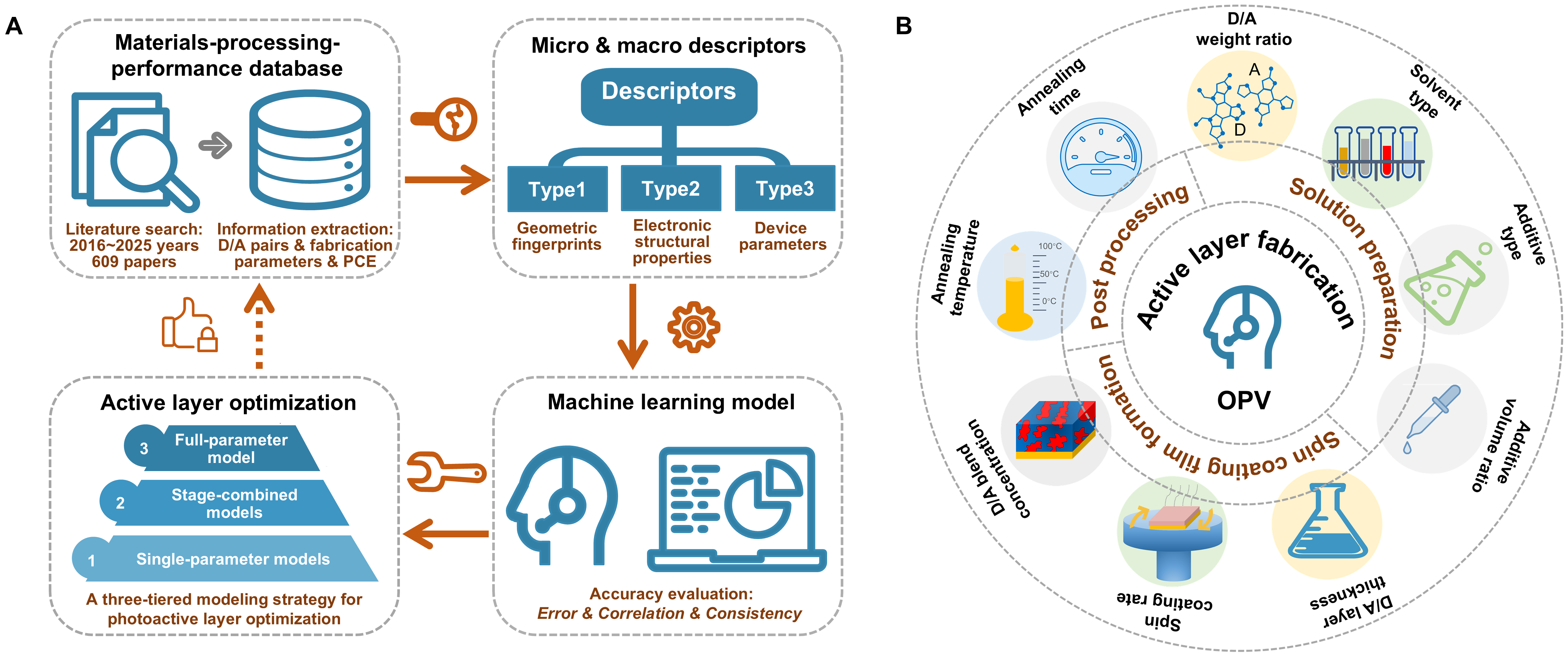
Recently, Wen Yaping, a young faculty member from the School of Chemistry and Chemical Engineering of our university, published a research paper titled Navigating high-dimensional processing parameters in organic photovoltaics via a multitier machine learning framework in Science Advances, a journal in the Science family. Wen Yaping is the first author and corresponding author, Professor Ma Haibo of Shandong University is the co-corresponding author, and Henan Normal University is the first author affiliation.
The optimization of organic photovoltaic cell performance is highly dependent on the nanomorphology of bulk heterojunctions in the active layer, while this morphology is in turn affected by the complex coupling of multiple processing parameters. Traditional experimental methods make it difficult to efficiently explore this high-dimensional parameter space, thereby restricting the development of high-performance devices. To address this challenge, the research team constructed a standardized database covering donor/acceptor pairs, nine key processing parameters and device efficiencies, systematically integrating experimental data published over nearly the past decade. On this basis, using the gradient boosting regression tree algorithm, the team developed a three-tier machine learning framework, including a single-parameter baseline model, a stage-combined model and a global nine-parameter optimization model, progressively revealing the synergistic and coupling mechanisms among parameters. This study provides an efficient tool for the rational optimization of active layers in organic photovoltaics and opens up a new pathway for data-driven materials processing science.
This research was supported by the National Natural Science Foundation of China and other projects. The achievement marks important progress made by our university at the intersection of organic photovoltaics and machine learning, and is of great significance for promoting the intelligent regulation of processing parameters for active layers in organic photovoltaic cells.
Paper link:https://www.science.org/doi/10.1126/sciadv.aeb1323
(Wang Manman and Li Bin, School of Chemistry and Chemical Engineering)