
 2026-05-02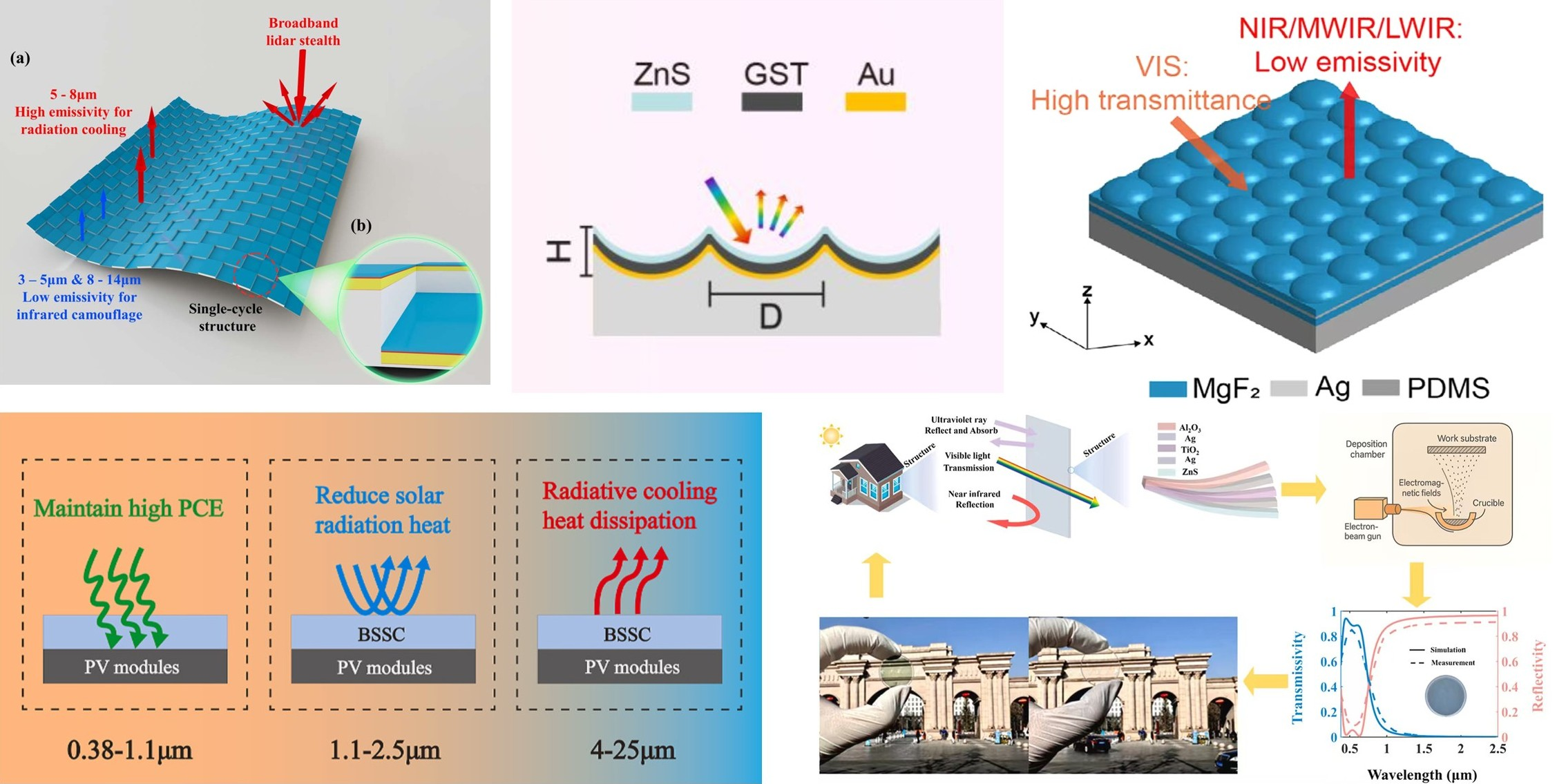
Recently, the team led by Professor Liu Yufang from the School of Optoelectronic Engineering of our university achieved a series of breakthrough advances at the intersection of photothermal control devices and emissivity measurement. The related achievements have been successively published in leading international academic journals, including Laser & Photonics Reviews, Advanced Photonics, Photonics Research, Energy, and Energy Conversion and Management. Professor Liu Yufang, Professor Yu Kun, Associate Professor Qian Mengdan, Associate Professor Zheng Shuwen, and Associate Professor Zhang Kaihua are respectively the first authors or corresponding authors of the relevant papers, with Henan Normal University as the first author affiliation and completing institution.
The team led by Professor Liu Yufang has long been committed to research on infrared spectral measurement technology and spectral regulation. It has successfully developed a series of novel metamaterial functional surfaces featuring flexibility, high-temperature resistance, dynamic self-adaptation, visible-light transparency and spectral selectivity, effectively addressing the core contradictions between stealth and heat dissipation, transparency and stealth, and power generation and cooling. Relying on a high-precision spectral emissivity measurement system independently built by the laboratory, the team has achieved high-precision characterization of the performance of related metasurface devices.
In the field of multispectral camouflage, the high-temperature-resistant composite checkerboard metasurface developed by the team can simultaneously realize visible-light color regulation, low emissivity in the mid- and long-wave infrared bands, and low-scattering characteristics for lidar. By enabling efficient heat dissipation through non-detection windows, it effectively solves the coordination problem between stealth and heat dissipation for high-temperature equipment. In addition, using femtosecond laser processing technology, the team successfully fabricated a multifunctional concave reflective metasurface. Through the synergistic effect of short-wavelength near-field reconstruction and long-wavelength far-field phase-gradient control, the metasurface achieved high-scattering regulation over an ultrabroad bandwidth of 0.8-14 μm, effectively resolving the conflict between infrared and laser-band spectral camouflage and providing new ideas for the development of multispectral compatible camouflage technology. By introducing GST phase-change material thin films, the team precisely controlled the switching of heat-dissipation channels from a “closed” state to an “open” state, realizing dynamic thermal regulation without affecting camouflage performance in other bands, with a maximum passive cooling effect of up to 20°C under high-temperature conditions. Meanwhile, in response to technical bottlenecks of traditional metasurfaces in broadband adaptability and scalable, facile fabrication, the team developed a transparent convex scattering metasurface based on a flexible PDMS substrate, and innovatively proposed an integrated fabrication process combining femtosecond laser direct writing and transfer-printing technology. The fabricated flexible metasurface can effectively suppress specular reflection across multiple bands from visible light and near-infrared to infrared, and can achieve high transmittance of 44% in the visible-light band, successfully realizing integrated multiband protective camouflage. Based on the flexible substrate structure design, the metasurface showed no obvious attenuation in optical and stealth performance after 200 repeated bending cycles, effectively filling the technical gap in mechanical durability for transparent camouflage equipment and laying a solid foundation for the practical application of flexible transparent stealth equipment.
In the fields of radiative cooling and building energy efficiency, the team designed two broadband spectrally selective coatings for the cooling of building-integrated photovoltaic skylights and building energy saving, successfully realizing the synergy of three core functions: high transmittance in the 0.38-1.1 μm band to fully ensure photovoltaic power generation efficiency; high reflectance in the 1.1-2.5 μm band to effectively block environmental heat input; and high emissivity in the 4-25 μm band to achieve efficient passive cooling. At the same time, the designed structures also feature self-cleaning and weather-resistant properties, providing a new solution for efficient thermal management of building-integrated photovoltaic skylights. In addition, the transparent heat-insulating reflective window developed by the team achieved an average near-infrared reflectance of 94.7% and a visible-light transmittance of 83.2%, providing a new solution for improving building energy efficiency, reducing energy consumption and enhancing indoor thermal comfort, and showing good prospects for industrial application.
This achievement represents another breakthrough made by our university in the field of photothermal control research. It strongly promotes the in-depth application and industrial transformation of spectral regulation technology in advanced camouflage, thermal management, green energy and other fields, and provides core support for technological upgrading in related areas. The above series of studies was supported by the Key Program of the National Natural Science Foundation of China, the General Program of the National Natural Science Foundation of China, the Natural Science Foundation of Henan Province, and other projects.
Paper links:
https://doi.org/10.1002/lpor.202503267
https://doi.org/10.1016/j.energy.2026.140125
https://doi.org/10.1364/PRJ.580597
https://doi.org/10.1016/j.energy.2025.139878
https://doi.org/10.1016/j.enconman.2026.121559
https://www.researching.cn/EN/HPArticle/AP-25-158412?type=en
(Qian Mengdan and Zheng Shuwen, School of Optoelectronic Engineering)