
 2026-04-17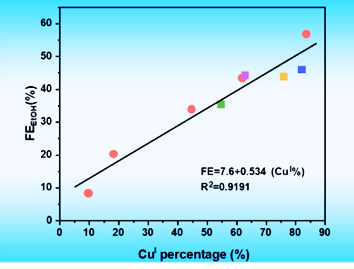
Recently, the Green Chemistry research team led by Professor Wang Jianji from the School of Chemistry and Chemical Engineering of our university, in collaboration with Academician Zhang Suojiang of Henan University and Academician Fan Maohong of the University of Wyoming in the United States, published a research paper titled Selective electrosynthesis of ethanol from CO₂ enabled by high Cuᴵ content and enhanced H₂O activation of molecularly modified Cu-based catalyst in Journal of the American Chemical Society, a leading international journal in chemistry. Wang Nan, a doctoral student of our university, is the first author of the paper; Professor Wang Jianji, Academician Zhang Suojiang and Academician Fan Maohong are the co-corresponding authors; and Henan Normal University is the first author affiliation.
Converting CO₂ into ethanol using renewable electricity is an important pathway to achieving the “dual carbon” goals and addressing the dual challenges of energy and the environment. It is also a forward-looking technology for converting CO₂ into high-value-added chemicals. In this study, through a pre-reduction strategy, the researchers prepared a Cu₂O catalyst modified with a benzene tetracarboxylic acid (BTEC)-Cu(I) coordination compound. The study found that the selectivity of ethanol electrosynthesis shows a linear relationship with the Cuᴵ content in the catalyst. The catalyst also exhibited excellent electrocatalytic performance: the Faradaic efficiency of C2+products reached 87.3%, with a partial current density of 676.0 mA cm⁻²; among them, the Faradaic efficiency of ethanol was 56.8%, with a partial current density as high as 439.8 mA cm⁻², and the catalyst remained stable during continuous electrolysis for 110 hours.
This achievement represents another important advance made by our university in the field of CO₂ resource utilization. It proposes a new approach for designing efficient and stable Cu-based electrocatalysts for the selective synthesis of multicarbon alcohols through CO₂ reduction, and provides new scientific evidence for an in-depth understanding of the structure–activity relationship and catalytic mechanism of Cu-based catalysts. This research was supported by the Key Program of the National Natural Science Foundation of China, the Henan Provincial Science and Technology Innovation Talent Program, and other projects.
Paper link:https://pubs.acs.org/doi/10.1021/jacs.5c19695
(Li Bin and Wang Manman, School of Chemistry and Chemical Engineering)