
 2026-06-16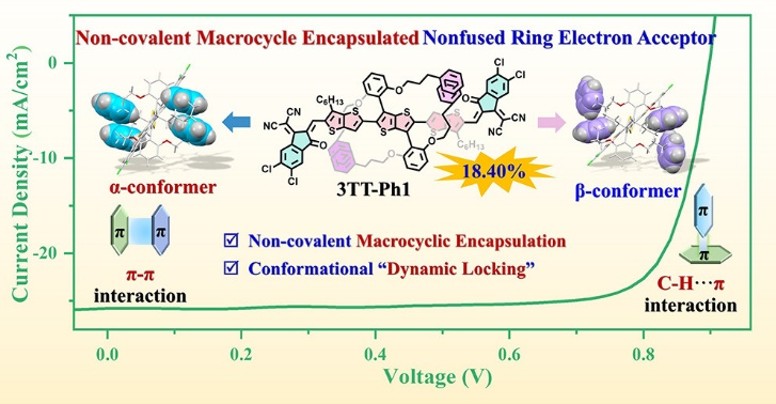
Recently, Associate Professor Li Miao of the Optoelectronic Materials and Devices Team at the School of Materials Science and Engineering of our university, in collaboration with Professors Liu Yahui and Bo Zhishan of Qingdao University and Professor Song Jinsheng of Henan University, have published a research paper entitled “Noncovalent Macrocyclic Encapsulation via Terminal ‘Dynamic Locking’ Enabling High-Performance Nonfused Ring Electron Acceptors” in the top-tier international chemistry journal Journal of the American Chemical Society. Zhou Yuanyuan, a young faculty member of our university, served as the first author of the paper, while Associate Professor Li Miao, Professor Liu Yahui, Professor Bo Zhishan, and Professor Song Jinsheng served as co-corresponding authors. Henan Normal University is the first author’s affiliation.
Nonfused ring electron acceptors have become an important research direction for organic solar cells due to their simple structures and low cost. However, the free rotation around their C-C single bonds tends to cause distortion of the molecular skeleton and diminished conjugation, thereby compromising charge transport performance. To address this key issue, the research team proposed a molecular design strategy based on noncovalent macrocyclic encapsulation, constructing a novel nonfused ring acceptor, 3TT-Ph1, by introducing phenyl units at the termini of the flexible chains. The results show that the terminal phenyl units form C-H···π and π–π noncovalent interactions, respectively, driving the phenyl groups to self-assemble into an intramolecular noncovalent macrocyclic encapsulation structure. This unique architecture provides an unperturbed microenvironment for the core conjugated backbone, ensuring efficient charge transport along the main chain. The innovative noncovalent “dynamic locking” mechanism balances the material’s solution processability with the ability to modulate thin-film morphology. Devices based on 3TT-Ph1 achieved a photovoltaic performance of up to 18.40%, representing one of the highest efficiencies reported to date for nonfused ring acceptor-based organic solar cells.
This achievement represents marks a further significant advance by our university in the field of organic solar cell research. It provides new insights for the molecular design of high-performance, low-cost nonfused ring electron acceptors and contributes to the industrialization of organic solar cells. This research was supported by the National Natural Science Foundation of China, the Natural Science Foundation of Henan Province, and the China Postdoctoral Science Foundation, among other projects.
Paper link:https://pubs.acs.org/doi/10.1021/jacs.6c02488
(Li Miao, Zhu Qianqian, School of Materials Science and Engineering: )