
 2026-06-16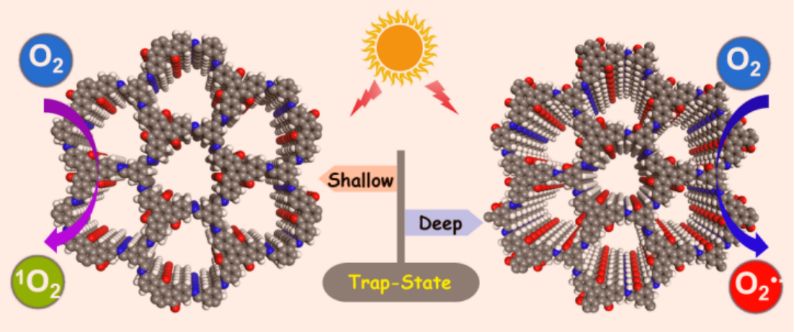
Recently, Professor Wang Jianji of the Green Chemistry Research Team at the School of Chemistry and Chemical Engineering, Henan Normal University, in collaboration with Professor Jong-Beom Baek of the Ulsan National Institute of Science and Technology, Republic of Korea, and Professor Li Zhongping of Jilin University, have published a research paper entitled “Electronic Trap-State Engineered Covalent Organic Frameworks for Programmable Selectivity of Photocatalytic Molecular Oxygen Activation” in the Journal of the American Chemical Society (JACS)—a premier international journal in chemistry. Qiu Jikuan, a young faculty member at the School of Chemistry and Chemical Engineering, is the first author of the paper. Professor Zhao Yuling, Professor Li Zhongping, Professor Baek, and Professor Wang Jianji serve as co-corresponding authors. enan Normal University is the first author’s affiliation. Henan Normal University is the first author’s affiliation.
Achieving selective generation of specific reactive oxygen species (ROS) has remained a major challenge in precision photocatalysis. In response, the study reports an electronic trap engineering strategy to control ROS selectivity in covalent organic frameworks (COFs). It was found that perturbation of the density of carbonyl groups and partial linkage tautomerization can systematically tune the energy depth of electron traps, based on which a series of topologically analogous COFs were designed and synthesized. This approach enables precise regulation of photogenerated charge carrier behavior and ROS generation pathways. Among these COFs, the shallow-trap structure facilitates stepwise charge separation that enables a sequential redox process leading to the generation of singlet oxygen (¹O₂). By contrast, deep traps stabilize photogenerated electrons and promote the selective accumulation of superoxide radicals (O₂•⁻) by halting further oxidation. Excessively deep traps, however, enhance charge recombination and thereby reduce the overall catalytic activity. The catalytic systems constructed on the basis of this mechanism exhibit remarkable selectivity across multiple light-driven oxidation processes, enabling on-demand regulation of different ROS generation pathways. Using molecular oxygen as a green oxidant and light as a clean energy source, the systems achieve highly efficient conversion under mild conditions, demonstrating excellent performance in areas such as green organic synthesis and solar energy utilization.
This achievement marks another important advance by Henan Normal University in the field of green catalysis and reactive oxygen species regulation. It offers new concepts and design principles for regulating photogenerated charge carrier dynamics and ROS generation pathways at the molecular level, as well as for the innovation of next-generation photocatalysts. The research was supported by the Excellent Young Scientists Fund of Henan Province and the Key Project of the Natural Science Foundation of Henan Province, among other funding programs.
Paper link: https://doi.org/10.1021/jacs.6c06033
( Li Bin, Wang Manman, School of Chemistry and Chemical Engineering)